Saturday, June 7, 2014

Italia Due: Mambo Gelato

After an even longer hiatus from blogging (due to a conflagration of Rhodes Ball planning, travel, visitors, and thesis writing, but that's fodder for a later date), I wanted to take a walk down what is now memory lane: the second half of my Italian trip, all the way back in April.

Now, when I left you last, Joe and I were getting ready to head to Milan to meet his family. I'd oversimplified that explanation a bit, so let me give you the full details of the complicated maneuver we had to pull off to get everyone in the same place. The schedule we had in front of us looked something like this:

-5:45 am: we head to the airport in Rome
-8:00 am: our flight leaves for Milan
-10:00 am: we arrive into Milan Linate airport
-12:00 pm: Joe's father arrives into Milan Linate airport
-12:30 pm: Joe's brother (Ben) arrives  in Milan Malpensa airport (40 km away)
-2:00 pm: Joe's mother arrives by train into Milano Centrale (in the center of town, 20 kms from each airport)
-ASAP: pick up the rental care from Milan Linate, drive 2 1/2 hours to La Spezia

Needless to say, we had to come up with a plan to round up the troops, especially since 3 out of the 5 people in our group had no way of contacting the other members! What we eventually settled on was Joe staying at Linate and working until his father arrived, me heading into town to meet his brother at the drop-off point for the bus from the other airport, and then locating his mother at the train station to head back to Linate, meet everyone, pick up the rental car, and drive to La Spezia.

Although just writing that sentence makes me tired and a bit stressed, the whole maneuver went off surprisingly well. In fact, I even had time to go to the Duomo, a beautiful church that also featured prominently in one of my art history books, for obvious reasons:
Mrs. Riley's train was delayed, so it was almost 4:30 by the time we got back to the airport. The family obviously had to have a brief reunion, but we hurried to get out of Milan before rush hour traffic got to its full Italian fury. And once again, luck was on our side; we made it out into the beautiful countryside without much problem, and drove almost straight into the sunset until we reached La Spezia, just in time to pick up our key from the apartment owner and make it to an authentic Italian restaurant where we finally could relax, catch up, and (naturally) eat far too much cheese and carb-y deliciousness.

I wouldn't be surprised if you haven't heard of La Spezia. The city itself is quite small, besides the large port; actually, it's known primarily as the entrance of a place you most likely have heard of: Cinque Terre, or 'Five Lands' in Italian. In case you're geographically inclined, here's the area on a map:

We spent the first morning in La Spezia, walking through a small market that was populated with some of the most adorable elderly Europeans I've ever seen:


And then we headed into the park via a short train ride. And let me say that the map above doesn't even come close to doing the place justice. Each one of the 'Lands' in Cinque Terre is a tiny cluster of brightly-colored houses built into rocky hillsides overlooking the sea and surrounded by the terraced hillsides that gained the whole area designation as a a UNESCO World Heritage site. In between each town are trails that wind up the mountainsides, each one taking about 1.5-2 hours to hike. We took the train out to the farthest town, Monterosso al Mare, and then hiked to the next town, Vernazza, which was my personal favorite:

 Then we took the train through Corniglia to Manarola:
 And hiked the last trail to Riomaggiore, but took a bit of break to enjoy some scenery :)
After watching the sun set over the water there, we went back to the city to eat at one of the most famous restaurants in town, which only opens if a critical mass of people book tables, and serves the chef's choice of the freshest seafood around.

The next morning, we'd decided to head into Florence, but a strike of railroad workers threw a wrench in the works, and we had to eventually drive there ourselves, so we only had a rainy afternoon to work with. Having to prioritize,  we first grabbed pizza for lunch and then headed to the Duomo, one of the most intricately-decorated churches I've seen in my long history of intricately-decorated churches.
 Then, of course, we had to have our daily obligatory gelato, which we ate while waiting in the long, rainy line at the Galleria dell'Academia, the home of Michaelangelo's David.
Luckily, though, we were able to pass some time by admiring some of the more amusing souvenirs we'd seen in our travels. Apparently, people are willing to pay exorbitant amounts of money to bring back a piece of the masterpiece for themselves!
I had heard many people say that the David is a piece of art that is better seen in person, but after having been to the Louvre and realizing that the Mona Lisa is about the size of an iPad (with much less color), I was skeptical. But let me tell you, conventional wisdom is completely correct in this instance! The David stands almost 20 feet tall, and the marble is worked so perfectly that you can see the anatomically correct veins and tendons in the man's hands. Unfortunately, no photos are allowed in the museum, so you'll have to go to Florence and see it for yourself if you want to verify my account.

Once we'd emerged back into the clearing sky, it was almost sunset, so we decided to take a quick walk down to the river banks and see the famous bridges before heading back to La Spezia. This one was my favorite, taken from the Ponte Vecchio and showing two other famous bridges across the Arno River:
Unfortunately, we had to hurry to drive back to La Spezia, because we were set to leave early the next morning to drive to Venice. Although one can drive along the highways and get there in less than 4 hours, we'd decided to make a day of it, and spent the morning winding through small villages in Northern Tuscany, up and over the Appenine Mountains.We stopped for lunch in a small town called Reggio Emilia for lunch, and strolled through the town square, finding the sweetest elderly couple on their own stroll.

 By the time we made it to Venice, the sun was setting, and the water bus we took through the canals to get to our hotel passed all of the lights blinking on. We were somehow exhausted after our entire day in the car, so we went straight to bed after we ate dinner, so that we could wake up the next morning to spend a whole day exploring the maze-like streets of the city.

We started with the Palazzo Ducale in St. Mark's Square, the home of centuries of doges, the rulers of Venice when it was the most powerful city in the world, at the center of both an unprecedented trading empire and the culture of the known world. We got there early enough to dodge the worst of the crowds, and even got to walk through the Bridge of Sighs, the link connecting the judicial wing of the palace that served also as the final court for all Venetian criminals, and the prison. It was said that passerby could hear the sighs of the prisoners as they looked through the barred windows to see the sky for possibly the last time...so naturally we walked by the outside to see what exactly it was they would have seen.
 After the Palace and St. Mark's Basilica, which was awash in gold, mosaics, and gems (and also prohibited photography), we wandered through the streets, finding beautiful little houses, gardens, and waterways around every turn. I'd heard mixed reviews on Venice, but I think it was one of the most enchanting old cities I've seen, and definitely the most unique due to all the water, which somehow is a different shade of blue in every canal. We even did the cheesy tourist thing at the end of the day, and took a gondola ride through the back canals with a very nice Italian man named Marco.
Although we were very reluctant to leave the beautiful watery city, we had a flight to catch the next morning in Bergamo, so we had to take the train back to the mainland and pick up our car to drive to our airport hotel. The next morning, we were set to fly to Greece. I was sad to leave Italy, but then again, I know that I'll be back.

Friday, May 16, 2014

Apassionatamente - Italia Part Uno

As we all know, I am quite behind on my blog. According to my last post, I'm still in Italy...and if only that were the case! In actuality, I am now writing from northern Spain. But you see, we've got much to cover before then. So let's get to it.

Because I can't even begin to describe the full awesomeness of Italian food (all at once rich, intriguing, fattening, and delicious, for starters), I will do my best to include more pictures than usual in this post, so that I can at least begin to convey the beauty of all that Italy has to offer. We spent almost two weeks in the country - the longest leg of our trip by far - and as a result, we saw what I consider to be an impressive amount of the country. For brevity's sake, only an overview of each place will be included. But never fear; if there is one thing I know, it's that I most definitely want to return to The Boot in the future.

After our whirlwind overnight travel from Fez to Rome, we had to wrap our sleep-deprived minds around the Italian train system. I can honestly say that I'm a bit surprised that we made it to Bracciano, the small medieval village an hour north of Rome on Lago di Bracciano, in good time. But somehow that was indeed the case. We were met at the train station by my contact from the house we rented, and she showed us to probably one of the most beautiful places I've ever stayed: a medieval farmhouse just steps from the beautiful lookout over the lake, and completely renovated within the past two years. It was just what two tired travelers needed, and we used it as our home base for the next three days.

After our intensive travels in Morocco (and Joe's food poisoning), the sleepy little village was a perfect and relaxing contrast. The lake is quite the tourist attraction in the summer, but since the weather wasn't quite warm, the offseason prices and smaller crowds still reigned supreme. The town is home to the castle where Tom Cruise married Katie Holmes, and we took a tour of the 15th-century structure on the second morning, and then spent the afternoon in a cafe, reading and checking our email, because medieval farmhouses don't often come equipped with wifi. The next day dawned sunny and unseasonably warm, so we hiked down the hill to the lake front and strolled in the sunshine, oogling the expensive houses that lined the shore and watching a small dog try to intimidate a swan from the sand.

More than anything though, Bracciano was a place for immersing ourselves in Italian food. We learned to eat in the four course Italian style: splitting an appetizer and a pasta, then getting our own main and following up with a dessert if we were feeling ambitious. I rediscovered my deep love for porcini mushrooms, and also blessed my tastebuds with pear and gorgonzola ravioli, linguine with homemade pesto, seafood risotto, grilled local lakefish...the list goes on, but I'm getting hungry just writing it!


I have to insert a little bit of a shameless plug here. Out of all the places I've ever been, Bracciano is definitely in the top five of places I would absolutely love to return someday. I happened to stumble across it while searching "hidden gems of Italy" online, but if you are ever looking for an Italian getaway a bit off the beaten path but still very non-Italian friendly, put it at the top of your list as well!

Anyway, after three days we had to tear ourselves away from our newest love. Since I took some art history classes in college that focused on the Classical period, I have been dying to go to Rome for some time now, and being so close, there was no possible way we were going to skip it! So we hopped the train back into the city (successfully again), and found our Roman apartment. Given the high prices of Roman rentals and our comparatively low budget, it wasn't nearly the palace we had in Bracciano, but our reasonably-priced apartment was in a bustling residential area reasonably close to public transport, so one can't really complain.

After only taking enough of a break to throw our things down and change into clothes more suited to the 70 degree weather, Joe and I hustled to the Coliseum so that we could hit the lunchtime lull of the crowds. I'd heard legends of how packed the whole area of the Forum and Coliseum can get, and let me tell you, every single one of them was true! We were able to bypass a 40 minute line by paying an extra 5 Euro for an audio guide (highly recommended, mostly for the time savings), and we emerged into the bright sunlight from the dark entryway.

I often find that the things you're most excited to see while traveling can also be the ones that underwhelm you, but this was definitely not the case. Despite all of the movies and pictures I'd seen, textbooks I'd read, and stories I'd heard, nothing can compare to standing in the presence of so much history. We spent over an hour strolling around the different levels, listening to history and taking photos and just imagining all of the events that had happened in this one building. Not to mention people watching! Let me tell you, the clientele here was nothing short of breathtaking.

 After the Coliseum, we went just across the road to the Forum, which was much more cluttered than anything I'd imagined. Although it was the absolute epicenter of Roman life from the Republic, there was never a comprehensive plan put in place, so what remains today is a jumble of amazing archaeological sites all squished together without much rhyme or reason at all. Even though we spent another two hours weaving among the ruins, I can honestly say that we became overwhelmed quickly, and I don't even know that the signs we read fully conveyed what we were looking at the majority of the time. Even so, it was beyond worth it to witness many of the temples and remains of countless buildings I'd read about in books for years.
 That night, we ate yet another delicious and cheese-filled Italian meal, and made plans to relax the next morning before our scheduled tour of the Vatican. Although there are many places I'm game to tackle alone, the home of the Pope is infamously overwhelming and chock full of priceless relics that can be easily overlooked if not pointed out carefully, so I was more than willing to shell out a bit of cash for a five hour comprehensive tour of the museums, grounds, Sistine Chapel, and St. Peter's Basilica. There were many times we weren't allowed to take pictures, but I did sneak one of the School of Athens (a famous Renaissance piece by Raphael that is widely hailed as one of the best early uses of perspective), which was one of my personal favorites. It was amazing how overwhelming the entire experience was; every single object in the complex is priceless, and it becomes almost dizzying after a while. At the very least, I became more skeptical of anyone claiming that the Catholic Church has a money problem!

 The rest of our time in Rome was a bit more slow-paced, due to a downturn in the weather. I went to several more churches, including St. John in Laterno (the original seat of the Catholic Church) and the Cathedral di San Clemente, which sits on top of a 4th century church and also a 1st century Mithraic temple.The Pantheon was obviously a must-see, although I found the new(ish) addition of a Catholic altar and relics jarring after having studied it in its original state, as a shrine to all of the Roman gods.

On the last night before we left Rome, Joe and I had an amazing dinner at a traditional Roman-style restaurant, the calm before the storm of yet another early morning flight to a new destination. This time, we were off to Milan to pick up the rest of Joe's family and start the Northern Italian leg of our journey!

Wednesday, April 9, 2014

Moroccan Kindness


For many years, I have had a strange fascination with Morocco. Something about the mix of cultures there, the famous architecture, the beautiful scenery, and what I’ve heard about the hospitality of the people has never ceased to intrigue me, and it has been near the top of my travel “bucket list” for almost as long as I can remember. In addition, I’ve known that traveling there would allow me to move one step closer to a major goal of mine: to travel to every continent besides Antarctica before I turn 25. So far I’ve crossed off North America (obviously the US, Canada, and Belize), Asia (China and India), Europe (England, France, Germany, Austria, Spain, Portugal, Hungary, Denmark, Malta, and Belgium), South America (Peru), and now, after all this time, I can finally add Africa (Morocco) to the list!
However, the journey didn’t necessarily start off in the idyllic way I’d imagined. After checking every day for weeks that the weather in Marrakesh was hovering around the seasonal average of 80 degrees Fahrenheit and sunny, I was shocked and dismayed when we touched down in weather that, at 50 degrees and rainy, felt much closer to England than the exotic land of wonders I’d imagined. After inching our way through passport control and haggling with a cabbie for a suitable fare into the Medina (Old City), we were dropped off at the end of a narrow alleyway and told vaguely to “just keep walking straight”.
Having been warned by our friends who have traveled to Marrakesh in the past that asking for any directions would cost us between 10 and 40 dirhams (from 1-4 Euro), we confidently brushed off all attempts to help and set off down the winding street, trying to skulk along under the awnings to protect our baggage from the continuing drizzle. As the road continued, seemingly endlessly, we began to lose faith, but then we finally emerged into a huge square. At first, I was excited, because I remembered that our hotel was supposedly very close to Jemaa al Fina, the major central square of the Medina. Then, as we scanned signs and saw nothing indicating our riad (hotel), we finally gave up and acquiesced to a man who had been pestering us for several hundred yards. He took us directly to the small archway leading to our hotel and wound us through the twists and turns, straight to the front door. He then yelled and carried on and tried to get us to give him 100 dirhams (10 Euro) for the less than 5 minutes of help we’d received, but we gave him 50 (which was still more than necessary by any account) and sought refuge in the dark reception area. 

It was a relief to meet our quiet but friendly riad manager, Abdul, and be shown to rooms that were small but clean and equipped with heat. I layered up with long sleeves and fleece, looking sadly at the shorts and dresses I’d been so excited to pack, and then we found our way back out to the square to eat at a somewhat tourist-y but reasonably priced Moroccan restaurant. Pretty much every restaurant in the country has a set menu price, so I paid it and selected the “Harira/Moroccan soup”, vegetable “tagine” (a traditional cooking method of a clay bowl covered by a chimney in which food is steamed), and mixed fruit salad with mint tea. The moment I tried the soup, I knew that I wouldn’t go hungry the entire trip! It tasted sort of like minestrone, but with lentils, chickpeas, and other veggies, and I proceeded to order it on pretty much every other possible occasion over the course of the trip. The tagine was delicious as well, and after the warm tea and fruit, we felt much refreshed, and set back off into the alleyways to attempt to find the museum and Koranic university I wanted to see.
Pretty much the moment that we stepped off the square into the “Souks” or narrow alleys that serve as residences, hotels, restaurants, and shops, we were lost. There are no street signs, and there is no discernible reason to the streets, which aren't straight or evenly spaced at all, so we had to stop and ask for directions twice before we finally found our way to the square we were seeking. Once, an adorable little boy who couldn’t have been older than ten grabbed my hand and walked us around for 5 minutes, then took 30 dirhams from us and pointed us down an alleyway that turned out to be a complete dead end! 

I was frustrated, wet, and cold by the time we found the museum, but we walked through the artifacts and enjoyed the beautiful architecture and tile work of the Ali Ben Youssef University. And beautiful it was! Like much of Old Marrakesh, both had been built in the 14th century, and had the intricate detail and beautiful color typical of Islamic architecture from the time period. 
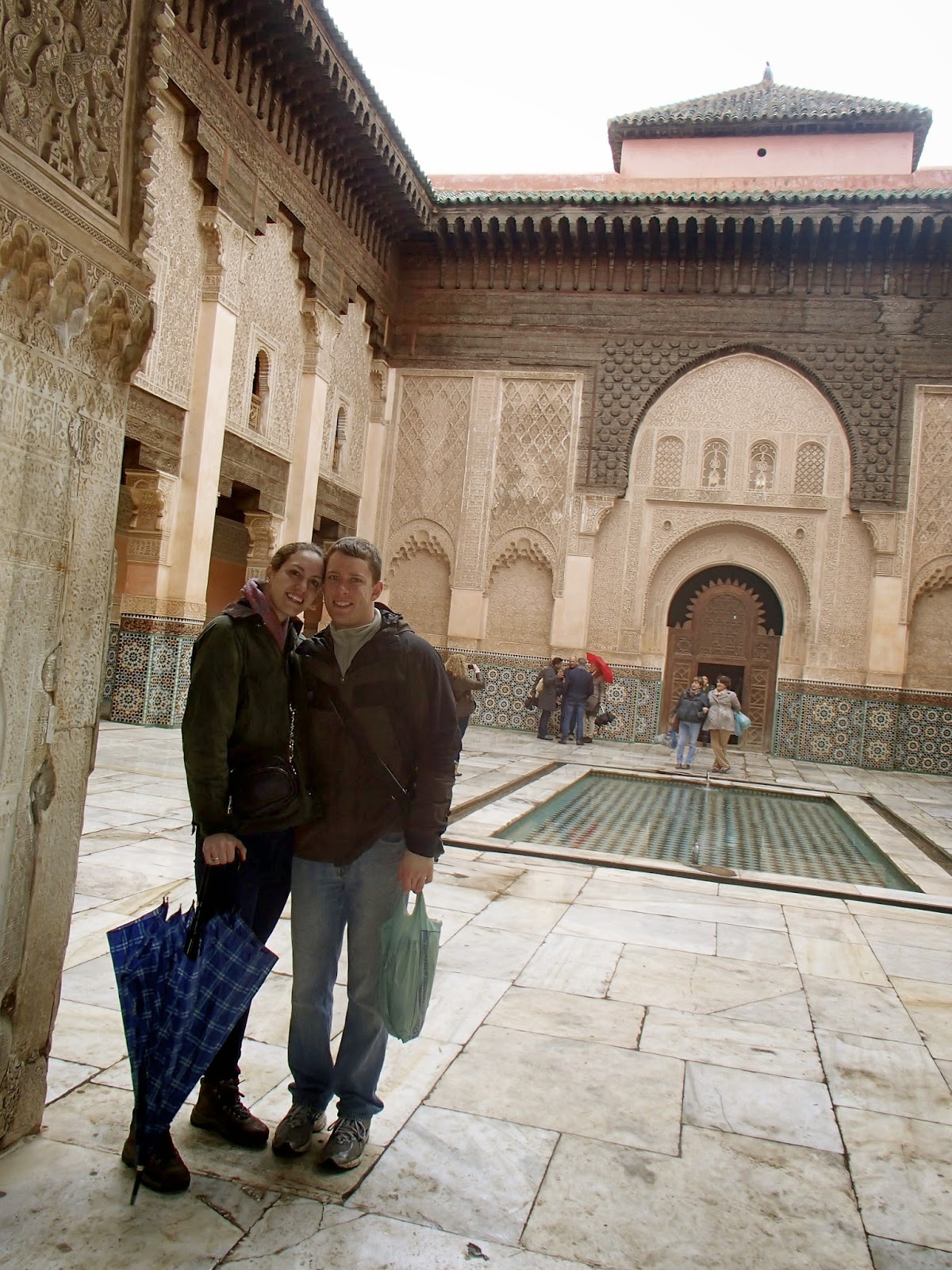
The rain had started up again in earnest when we stepped outside, and we tried desperately to retrace our steps back to the big main square so we could find our riad and have hot showers and a short siesta before it was time for dinner. We wound our way through the streets for over an hour, and finally paid again for directions back to the big square…so imagine our dismay when we ended up in the exact same place from which we’d departed over an hour ago! Now, both to save some little bit of my pride and reinforce how convoluted the Medina is, I would like to stress that I normally have a very good sense of direction, and this was the first time I can ever remember that I managed to get so completely and irreparably lost that I walked in a circle without ever realizing it.
After a few moments of silent fury and disbelief that finally lapsed into laughter, we set off again, and this time were successful in making our way back to the riad without incident. For dinner, we stayed on the beaten path by retracing our steps to a beautifully tiled restaurant entry we’d spotted not too far from our hostel. Once we found our way inside, we discovered a huge and intricately decorated room with traditional Moroccan music playing and a wide selection of foods served in huge portions. After the long, wet, and frustrating day, it was exactly the sort of thing we needed, and we even managed to look past the somewhat tourist-y veneer to enjoy ourselves. Between the food and the walking, I slept hard that night, and woke up in the morning glad for a new day to try again with Marrakesh.

But when I walked outside, it was raining and cold once more, so we changed our plans slightly and booked a hammam, or traditional bath, for the afternoon.  Because of its high volume of tourists, Marrakesh has hammams that offer both traditional Moroccan and more classically Western spa treatments, so we found a package that would allow for the steam, soap, and scrub typical in Morocco and a TWO HOUR massage…all for only 60 US dollars! In the mean time, we ventured through the markets to pick out the few scarves, soaps, and other gifts we wanted to pick up for friends and family. We made a lunch of the fresh squeezed orange juice, dried fruits, and roasted nuts sold in bulk at many small stalls, and purchased enough extra to bring with us on the desert trip starting the next day. Abdul had a friend who worked at the hammam we’d booked, and she was nice enough to come to our riad to guide us through the confusing alleyways so that we made it to the hammam in a timely manner. We were treated to more mint tea on the rooftop while everything was being prepared, and then eventually changed into our robes and flip-flops to start the afternoon. First, we spent about half an hour in the steamy sauna, where a pleasant middle-aged woman first rubbed us down with the “black soap”, a gooey dark green gel, and then let us sit for a period of time. Then she put on an exfoliating glove and scrubbed us hard, laughing at our shock when we saw our skin rolling off in little tubes. Finally, she shampooed our hair and applied argan oil, and then let it sink in before escorting us back downstairs. The massage was absolutely amazing after that, and we practically slithered out the door, so relaxed were we after our first experience with the baths. We then had enough time to pack up our things and buy some movies before dinner, which was at a rooftop restaurant recommended by Abdul. By evening, the sun had finally made an appearance, and we enjoyed our harira, tagines, and tea while we watched the sun set. Then we all three climbed in bed to watch a comedy before an early morning wake up call for the desert tour.
Our guide came to pick us up at the riad in the morning, so we hugged Abdul goodbye and followed him out to a Toyota Land Cruiser with a smiling driver. The driver was introduced as Ibrahim, and the guide (who spoke perfect English) told us that his name was Driss. As we slowly wound our way out of the Medina and into the Moroccan countryside, he explained the plan for the next four days in the desert, which would ultimately end with us being dropped off in Fez. Then he fielded all of our questions we’d had pent up about the people, culture, and customs of Morocco. After a few hours of winding through the green mountains, we found our way to a small rest stop, where we stopped for a snack and bathroom break. I took the opportunity to snap a quick picture of this portion of the beautiful Moroccan landscape:
 Then, we wound higher and higher up through the Atlas Mountains, on a narrow road that often came scarily close to sheer dropoffs. I can't remember a time in the past when I've ever gotten carsick, but after offering to sit in the cramped middle to keep Joe and his mom more comfortable, I was feeling more than a little bit queay. So I breathed a big sigh of relief when we stopped at a beautiful lookout to take pictures, and I could climb out of the back to get some clean, cold air. After only about three hours, the flat desert scene of Marrakesh had given way to something quite different:
The point where we stopped was close to the peak of the mountains, and we slowly wound our way down the other side, which was luckily not as curvy or narrow as the Marrakesh side of the mountains. Still, I was more than happy to get a few hours' respite from the Land Cruiser, when we stopped at a small town in the desert that has sprung up to accommodate tourists visiting one of Morocco's most famous sites, the Casbah of Ain Ben Haddou. After a lunch of cous cous and vegetable tagine, we hiked a short path to get a view of the casbah, which is a UNESCO site and has also hosted the crews of movies as famous as Lawrence of Arabia and Gladiator, and even the TV show Game of Thrones! Then we set up the winding path through the mud and straw buildings. Although the casbah traditionally only housed one family, today there are nine different families living inside the outer walls. It was a steep trail, but the top offered beautiful views of the desert and the casbah itself.
After spending enough time at the top to take pictures and be harrassed by a young Moroccan boy who followed us around angrily repeating, "Money! Money! Money!", we clambered our way back down the reddish paths and reluctantly got back in the car for the remaining hours of our drive. That night, we stayed in Ourzazate, which is on a high plateau with a perfect view of the sunset and a gym, which was much needed after the cramping of the car. It was also remote enough that it was pitch dark when the lights turned off, so I slept amazingly well.

The next morning, we had planned to leave around 9, but got a late start because Joe woke up with a terrible stomachache, presumably from something he'd eaten the night before. I felt terrible for him, especially because we only had about two hours of highway driving that day before we had to start our offroad trek through the desert, which is a bumpy road under any circumstances. Before that time came, however, we went to Three Gorges, which is a huge natural canyon at the mouth of one of Morocco's largest fertile valleys. As we stopped at the entrance, evidence of Morocco's rich mineral deposits was apparent in the hillsides:
In the canyon, there was a crowd of people: locals selling souvenirs and handicrafts, herdswomen bringing their goats, sheep, and donkeys to drink in the river, other tours, and even rock climbers clinging to the rocks on the either sides. Although the sheer size of the place, worn by millenia of water flowing through it, meant that I couldn't really capture it with my camera, but this panorama shot was my favorite by far.
After we lingered around the canyon for a while, we had to set off once again to finally start our offroad trek. I felt terrible for Joe, noticing him become progressively more green as we bumped over the rocky desert, but he was a champ and didn't complain one bit. Moroccans say that there are actually three types of desert: mountainous desert, rocky desert, and sandy desert. We'd glimpsed the mountainous desert going up through the Atlases, but now we were down in the rocky part, where the mineral deposits turned the landscape different colors. We even passed through a greenish desert, which I found fairly ironic. For the most part, however, we were in the blackish-brown volcanic desert. The sand that was picked up by the wind and flung in our faces stung, and Joe eventually asked our guide to tie him one of the Berber turbans to protect his ears and neck.
By the afternoon, we were in Berber territory. Although a portion of the Berber people are still completely nomadic and move their herds across borders freely, tightening border controls and economic difficulties have meant that many former nomads have settled down to become farmers and tradesmen, most in small villages that dot the landscape of Morocco close to the Algerian border. Because our tour company, Rough Tours, was started and is staffed by all Berbers, being in the area necessitated our stopping at no less than four houses along the way, so that we could all pay visits and drink tea. At each of the houses we stopped, the people were friendly and excited to have us, and we always enjoyed ourselves, even if we needed Driss to interpret everything. Although none of the people were rich by Western standards, each of them put out their best nuts, breads, and snacks in front of us with the tea, and the women would all scold us, "Chat! Chat!", which means "eat! eat!" in the Berber language. We were so touched by their hospitality and generosity that all of us, even sick Joe, felt that we had to take them up on their offers. Driss explained to us how all Berbers are expected to show kindness to guests, no matter how difficult their own circumstances, and I thought that was the most beautiful thing I'd heard about in the country. We asked him why they always served tea so ceremoniously, lifting the teapot high over the tiny glasses but somehow never spilling a drop, and Driss laughed. "There is a Berber saying: tea without foam is like a Berber without his turban!" 

 We spent so much time with each family, showing pictures of our homeland and trading stories of our lives, that we got to the village where we were to spend the night rather late, just as the sun was setting. We went straight to the small auberge, or guesthouse, where we'd be spending the night, but Driss promised we could go back into the village in the morning to meet people and see the farms, school, and livestock pens typical of Berber homes. The sun was already setting when we pulled in and got ready for dinner, and once we ate, we all fell straight into bed.
Joe was up most of the night with a fever and stomach cramps, so after a simple breakfast of bread and water, we sent him back to bed to rest while Mrs. Riley and I went into the village, called Ramlia. We first toured one of the two schools in town; we weren't allowed in the government school, but we could see the building that served as a preschool for children younger than 6 who couldn't yet go to the state school, and also was a place for the volunteer teacher in town to teach basic English to the children. The teacher, Anna, is a middle-aged Australian woman who has been living in Morocco for three years, alternating between Ramlia and a village in the north of Morocco. She told us about the difficulties of teaching an optional program in an agrarian community, where kids are often held out to help around the house or farm, and many families don't even see the need to send their children at all.  When we were in the building, the preschoolers came in to have their lessons with a teenaged girl named Khadijah who teaches them the Arabic, English, and Berber alphabets and some verses from the Koran. Mrs. Riley and I tried to teach them how to play "Ring around the Rosie", but that didn't catch on too well with them, as they were confused by the song.
Next, we tried "Duck, Duck, Goose", and got significantly more interest in that game. I asked Driss if he could tell me the Berber words for animals the kids were used to seeing, like donkeys, sheep, and goats, to see if that would work better than ducks and geese they'd probably never even heard of. He shook his head and said, "Watch, they won't need words." So I watched the first little girl walk around the circle, touching everyone on the head silently as she walked by. Finally, she paused in front of a little boy, smacked him on the head hard, and ran off laughing while he chased her angrily. Mrs. Riley and I burst out laughing, and the kids absolutely loved it. I guess we didn't realize exactly what sort of abuse we'd introduced into the little schoolroom!

Afterwards, we walked around the farm plots, or "gardens" as Driss called them, as he explained the irrigation and farming techniques for different crops grown in that village. We'd picked up a small shadow when we left the school: a little girl named Ibisha who silently grabbed my hand and led me through the gardens behind Driss. When we finished our tour, it was time to go, but I was surprisingly sad to leave the people who'd shown us so much hospitality in our short time with them. I knew that we had a schedule to keep though, so I hugged Ibisha goodbye and got back into our trusty SUV for another day of bumping across the desert.

Much earlier that I'd thought, we got back onto smooth, paved roads, and Joe was able to take a bit of a nap through the monotonous desert. We stopped for lunch in a village that's a traditional Gnawa, or black tribal Moroccan area, and were able to listen to some of their traditional music while we were waiting for lunch. It was rich with drums and chanting, and I could see why Moroccans hold a yearly festival to celebrate it. Our lunch was of "Berber pizza", a dish that was almost a calzone of the bread we'd been eating but filled with rice, spices, veggies, and eggs. It was delicious, so I ate up, and since Joe was starting to feel somewhat better after his rest, he tried some as well. After storing everything we wouldn't need for the night in a hotel, we then were set to embark on our biggest adventure yet: a camel ride through the Sahara desert! Joe's family has horses, and I've ridden in the past, so we were confident we'd be fine with the camel riding, but had no idea how different it was. The camels layed down so that we could clamber up in the saddle, and then we had to hold on tight while they found their way to their feet. Then, when we'd gotten settled on the soft saddles that fit around and over the hump, we started off at a walk. The gait of the camel was slow but lurching, and I quickly realized it wouldn't be nearly as comfortable as riding a horse.
 For two hours, we rode along the sand dunes, our camels carefully picking their way behind our guide. The slow pace was perfect for taking pictures, but I quickly realized I'd have to still pay attention, because my camel was devious. When we were less than five minutes away from the departure point, she slowed down until Mrs. Riley's camel was far enough ahead to stretch the rope that bound them together, and then she yanked her head back hard to disentangle it, and started moseying along in her own direction! Luckily, the guide, Ibrahim, paid closer attention to her after that, and we didn't have too many other problems on the way to camp.


We stayed in a set of tents protected on either side by two sand dunes, and got there in time to climb up one to watch the sun set over the desert. Mrs. Riley took a few turns on the "sand board", a snowboard that had been greased to allow it to slide down the dunes, but I considered the long distance from civilization and decided against trying anything that could put me in need of emergency medical attention.
We waited for dinner and chatted with the other travelers staying at our camp: four Germans, an American family on their son's high school graduation trip, and two American girls working for the Peace Corps in Morocco whose two friends were visiting them. The dinner was huge tagines and more cous cous, and I was glad to see that Joe was feeling well enough to eat a normal dinner, and his fever had gone down. The guides treated us to some Moroccan drum music and dancing around the campfire, but I was more interested in watching the stars, which were out in droves thanks to the lack of light pollution that far out in the dunes.

Looking back on it, I'm glad we went to bed early, because Joe woke up in the middle of the night and we quickly realized he shouldn't have eaten the big dinner. His fever was up again, and he was covered in sweat and cramping so badly that he couldn't sit up. There was a point when I was legitimately worried that I would have to get the guide and bring him back to the town, but around 3 am his fever broke and he was able to get some sleep. I got up at 6 to watch the sunrise, but I left him sleeping, hoping that he'd get enough rest to be able to make the long camel trip back.
After he woke up, the fever was still gone, but he felt weak after the night before, and I take it as a testament to his endurance that he was able to make the bumpy and uncomfortable camel ride back to the hotel. He called his dad, who's a doctor, the moment we got back, and got instructions for how to get over the last little bit of whatever it was he had. Then we showered the sand off and ate a quick breakfast before beginning our long last leg of the drive, which was almost 600 km north to Fez.

It took us over the mountains again, so we had the strange experience of seeing the Saharan desert and snowy pine forests in the skiing area of Morocco in the same day. Needless to say, we got some strange looks when we stopped at a rest area still wearing shorts and sandals from our desert morning.
It was almost 8 pm by the time we made it through the mountains to the green, fertile, and non-snowy area around Fez and said goodbye to Driss and Ibrahim. They were both absolutely amazing, and if any of you are thinking of going to Morocco, you should most definitely look into doing a Rough Tour. 

This has already been a long blog entry, so there's not much else to remark upon in Fez besides going to the leather tannery, which still treats and dyes leather using the traditional techniques. It was a bizarre place, and smelled worse than probably any other single location I've been in my life. Nonetheless, it was still interesting to see the workers moving among the catacomb-looking vats, shifting hides around and treating them with different chemicals. Each week, the dye vats are filled up with a single color, and only items that color are treated over the seven days. While we were there, it was a red week.

We only had one day in Fes, and in the evening had to start our long journey to Italy (for Joe and me) and Innsbruck (for Mrs. Riley, who was planning on skiing with some of their German friends). First, we took a 4 and 1/2 hour train to Casablanca, and then had to find our way onto another train to the airport, which took another hour. Then we had to wait until 1 am, when our gate opened, and go through security to wait until our 3 am plane, which landed in Rome at 7 am. It was one of the more tiring travel experience I've had, and I was ready to kiss the ground when we landed safely on Italian soil. Then again, a new country brings with it all new stories, and I don't have time nor space to begin on the Italian ones here.


Saturday, March 29, 2014

Ethpaña


Once again, Joe and I found ourselves on the 4 am bus, this time to London Gatwick airport to start our month long Spring Break travel. We’ll eventually end up in parts of Spain, Morocco, Italy, and Greece, but this first leg was to visit Joe’s brothers and mother in Madrid, so we only had a quick two-hour flight.
We had been torn about luggage, because although I am a light packer, even I couldn’t manage a month’s worth of clothes, my computer, books, and toiletries in the one backpack that Easyjet allows for free. Joe was planning on doing a bunch of reading, so had to bring a separate bag just for books and his computer! Because checking a bag costs 75 dollars, more than twice the amount of money we paid for the flight, we sort of skulked our way through the airport, trying to see if we could find a nice employee who would let us through without protest.
Security was no problem, and when we got to the actual gate, Joe managed to conceal his side bag under his jacket and waltz through. Stepping up just behind him, however, I was treated to a disapproving frown. Although I protested cursorily, I knew I had no chance, so I rolled my eyes and paid the fee.
Once we were on the plane, however, everything went rather smoothly. We landed on the other side and were able to quickly get through passport control and find a taxi to take us to the hotel where Joe’s mom and youngest brother were staying. Joe’s middle brother, Benjamin, is currently studying abroad in Madrid, so he was in class, but had promised to meet us at the hotel for lunch once he was finished.
We had the perfect amount of time to drop everything, change clothes, and then head back into the city, hopping on the Metro in order to get to Mercado San Miguel, a closed in market with an amazing selection of food, tapas, and drinks right in the centre of the city. Once there, we broke off and scoured the market, each coming back to the assigned meeting place with different goodies. I found paella and some delicious cheese with olives, Mrs. Riley ended up with ham, calamari, and wine, and Joe and his brothers came back with different rice, cheese, and sort of hot pocket-y selections themselves. We had a feast of randomness, and then all decided to get some frozen Greek yogurt before venturing back out into the city.

We were very close to Plaza Mayor, which is a huge central square with a ton of restaurants and street performers. We walked through to admire the architecture, but we left rather quickly after being accosted by a variety of street performers due to a rather slow day. Then we hopped back on the subway to head to some of the largest gardens in Madrid, and spent a nice hour walking around and taking pictures while enjoying the sunshine. At the back of the gardens is an area called the Crystal Palace, a large and ornate greenhouse structure that was full of beautiful afternoon light. Inexplicably, there was a square of carpet with a lone top hat in the middle of the large space, and Joe’s brother asked why it was there. The woman working the door looked at us like we were idiots and replied that it was quite obviously part of the 1870’s aesthetic. After looking around in bewilderment at the sparse glass and cement room with only the carpet and top hat to break up the transparency, we rolled our eyes and moved on.

Not far from the square is El Museo Nacional de Prado, which is one of the premier Renaissance and 17-19th century art museums in Europe. Only Joshua, Joe’s youngest brother, and I were even remotely interested in going in, so we got our free student entrance while the rest of the crew headed back to the hotel for a “siesta”. Inside the museum, we found an amazing selection of sculpture and paintings ranging from artists as famous as Rembrandt and El Greco to obscure names we’d never heard of. We strolled through, and stopped several times to admire the art students dotted throughout the halls who were painting reproductions of famous works hung there.

Once we were tired from walking and beginning to think of dinner, we hopped back on the Metro and went back to the hotel to round up the rest of our group. We then piled into a cab and headed to one of the main restaurant areas, a street full of somewhat tourist-y but still reasonably priced Spanish restaurants. Then, we had a feast! We found a place with a gregarious and loud owner standing out front, who then beckoned us in and put together a menu of fried seafood, paella, vegetables, and sangria, and we ate probably more than anyone ever should. And it was delicious! In traditional Spanish style, it was probably a two-hour meal, and yet Joe was somehow still hungry as we lumbered back toward the Metro.  So we ducked back into the market for another round of Greek yogurt, only to spot some similar faces in the crowd. Two of our Rhodie friends had told us they’d be traveling in Spain, but we never thought we would run across them in a crowded market in Madrid! We had some good laughs and wished them well on their travels, but the 3 am wakeup was starting to catch up to us, and we didn’t stay long to chat.

We all fell straight into bed when we arrived back at the hotel, because we knew we’d be getting up early to catch a train to Toledo, a medieval city only a half hour away from Madrid. While Madrid is now a booming metropolitan center with only a few areas resembling the Old Spain of empires, Toledo still has a beautiful walled historic centre on a bluff overlooking scenic countryside. After finding the Metro route to the train station, we grabbed sandwiches and coffee and ate them as we watched the countryside flow by. Weirdly, it reminded me of areas of Northern California that I’ve driven through on past trips.


When we arrived in Toledo, we could immediately see the difference from the lovely Moorish-style train station and the patiently waiting bus that wound us up the long hill, offering beautiful views of the old city the entire way. It dropped us in the central square, and we immediately walked to the edge of the bluff to enjoy a small park and the panoramic views. Then we spent some time winding through the steep stone streets, discovering pretty little plazas and many shops around different corners. We eventually ended up at the Catedral de Toledo, and although I was initially wary of the 8 Euro entrance fee, I completely understood the price once we were inside.
As someone who loves old churches, I’ve seen pretty much every style you can imagine. I can’t, however, really explain the beautiful mix of Gothic architecture, Renaissance art, and skilled sculpture work inside this cathedral. It took over 250 years just to complete the structure itself, and the art was completed almost 100 years after that. The altarpiece is the most intricate I’ve ever seen, an almost unintelligible motley of golden and brightly colored saints, disciples, and angels soaring up hundred of feet. Behind the altar is another art piece, a marble sculpture of angels that seems to be spilling from a high window down along both walls toward the floor. And then off to the side is the Sacristy, with an original ceiling painted by El Greco that is both huge and absolutely beautiful. The Sacristy now houses the art collection of the cathedral, which is extensive and contains impressive names from the Spanish Renaissance. Even beyond that the wonders continue, as an outdoor courtyard garden is surrounded by beautiful frescoes detailing the works of Spanish saints. Off that courtyard, I found my favorite part of the entire complex, which was a small room dedicated as the tomb of a Bishop, but containing some of the most amazing frescoes I’d ever seen. Apparently this official had gone to Rome for some time, and had brought back with him several masters to start the style of art in Spain, so when he died, each of the most accomplished Spanish fresco artists descended to decorate his tomb. I spent so much time in that room admiring the artwork that I found I’d lost Mrs. Riley, and made a quick lap of the cathedral before finding her outside, listening to a cellist who was playing beautiful music in another courtyard.


We headed back to meet up with the boys in another square, where they’d exited the church early to sit and drink coffee in the sunshine. After wandering for a while, we found a very reasonably priced restaurant, and split paella and pizzas for lunch. Then we set off back into the city, winding through the shopping districts, where I purchased an ornately painted ceramic plate in the almost Moorish style very popular in southern Spain. We eventually came back around to the road the winds several kilometers down the hill towards the train station, and decided to spend our last two hours walking slowly and exploring the route. We found a park with beautiful arches of wisteria full of Toledan schoolchildren playing while still in their uniforms, and also took a detour to sit down by the river and enjoy the view of a Roman arched bridge that has stood for centuries. When we finally found ourselves back in the area of the train station, we had just enough time to enjoy an afternoon coffee in a pretty little café before we had to get back on the train to Madrid.

For dinner, Benjamin took us to one of his favorite tapas restaurants, where a huge glass case held small sizes of dishes ranging from a ball of fried potato filled with meat to smoked salmon and fried eggplant, and we tried a selection that ran the gamut. By the end, I thought I would explode if I ate anything else fried or a single piece more of cheese. After such a heavy dinner, it was all we could do to make it back to the hotel before falling asleep.
It was only a brief time in Spain, but it was absolutely lovely, and made me realize that I need to go back to see the other regions and gorgeous old cities. The next morning, we boarded a plane to Marrakesh….but Morrocco is another story for a different day.

Friday, March 14, 2014

Bathception and Towering

The last few weeks in Oxford have led me to a somewhat unbelievable conclusion: spring is springing here! I can't say it's sprung already, because we've still had a smattering of days where my breath visibly precedes me as I ride my bike to class, but overall the weather has gotten noticeably sunnier and warmer, and daffodils, crocuses, and cherry trees are all starting to bloom and break up the pervasive grey that defined all of the winter months.

With the better weather have come many visitors and more opportunities for outside activities (along with a generally more positive outlook on life in general). First, I was finally able to climb Magdelan Tower, which is basically a rite of passage here. I never understood why it was such an accomplishment until I saw the hundreds of narrow and steep tightly spiraled stairs in the dark tube up the tower. Being both somewhat afraid of heights and a tad claustrophobic, I considered myself pretty darn lucky to have made it to the top! Once there, however, we were treated to beautiful views of all of Oxford that made the climb completely worth it, including a panorama of the High Street leading up to the City Centre:
Due to the Tower's prestige among students, none of us could turn down the priceless photo opportunity, so we shamelessly snapped pictures like tourists on their first day in the UK:

(the others pictured are 2nd and 3rd year Rhodies, and one visitor in town from China). After the tower, we strolled through Magdelan's famous deer park, including a section called Addison's Walk, which is quite famous. You see, there was a long period when both J.R.R. Tolkein and C.S. Lewis were fellows at Colleges here (Merton and Magdelan, respectively), and they became very good friends. Lewis was a noted atheist, and Tolkein was a devout Christian, and they used to spend a lot of time walking along this particular path and talking about their beliefs. It was during his time at Oxford that C.S. Lewis became a Christian, and as some of y'all may know, he later on became one of the most influential Christian writers of modern times. As such, we came across a memorial stone that's been put up to the memory of the two great men, and inscribed with a Lewis poem that seemed to me when I read it to have been written just particularly for this time of year:
Needless to say, it was a pretty cool day to be had in terms of Oxford experiences. The next day, I had a friend of mine from high school who is living in Germany into town, meaning that yet another day of possible academic productivity was sacrificed (not so reluctantly, to be honest) to touring around Oxford in the beautiful weather. I took Tommy to see Christ Church, the college where much of the Harry Potter movies were filmed, the Ashmolean (an amazing museum in town run solely off donated and loaned relics), lunch at The Eagle & Child (a pub famous for its literary guests, Lewis and Tolkein among them), and then in the afternoon we climbed yet another tower. This time, it was that of St. Mary's Church, which is right in the middle of the city centre, and actually overlooks my college, Brasenose. Here's one of the most famous views of Oxford, which you will probably recognize from just about every Oxford publication.
After he left to head back into London, I had to scootch on home to quickly get ready before a Guest Dinner at St. John's with Joe. Guest Dinners are black tie formal four course affairs, and we all love them as an excuse to get dressed up and eat an amazing meal (with lots of free wine!) with friends. This one was particularly special, as several Rhodies had their significant others in town from the States. We took the opportunity of being all dressed up for the girls to take some pretty pictures:
After the meal and post drinks, we were all so exhausted that there was really no option but to head home and sleep. Saturday was a study day (as penance for the fun of visitors in town), but we did get to have a full Southern meal together. I think I've written previously about the NOMs cooking group that we do all together, and since one of the other Southerners had her boyfriend in town from North Carolina, we decided to throw a full on artery-clogging feast in his honor. There was pulled pork, macaroni and cheese, cornbread, coleslaw, and pecan pie, and it was undoubtedly a success.

The next day, four couples (Joe and me, and then three other Rhodies whose partners were in town) organized a trip to head to Bath, a city in the UK famous for its history and spas...incidentally, two of my favorite things! When we woke up and walked outside, we couldn't have been happier; it was the sunniest and warmest day we've had since probably the first week we arrived in the UK in October. Considering the high was 55 degrees, I got to have the liberating experience of ditching my heavy winter coat in exchange for a vest and long-sleeved shirt.

Although there's one switch, it's still only about an hour and a half train ride from Oxford to Bath, through a beautifully agricultural section of Britain. Once we made it to the city, we made a beeline for an ice cream shop, and ate our cones as we strolled toward the city centre.

I should probably give a quick preface to say that Bath is famous both as one of the premier sites of Roman ruins, due to the baths that were built there to take advantage of the natural mineral hot springs, and for a renaissance during Georgian time that led to amazing examples of architecture (and several mentions in famous Jane Austen novels). Therefore, our first stop was Bath Abbey, a huge and absolutely gorgeous neo-Gothic cathedral that marks the centre of town:
We'd planned for the next stop to be the Roman baths, but when we realized that they were rather small and cost 13 pounds to enter, we decided against it and moved on to the Circus, which is a famous "roundabout" surrounded by buildings made into a perfect circle. Joe and I had to take a cheesy couple picture, of course:
After that, we made our way back down to one of the beautiful parks along the river and joined the ranks of the people laying in the grass to bask in the sun. It was only about half an hour, but I swear it was as therapeutic as a week at the beach.

The last thing we'd planned for the day was to attend one of the new baths (in Bath, hence Bathception) that have been built to take advantage of the same mineral springs the Romans discovered thousands of years ago. Nowadays, these baths include saunas, steam rooms, and multiple levels, including a rooftop pool with gorgeous views of the city. We'd found a deal affordable on grad students' budgets that included dinner, so we spent a full three hours relaxing, eating, and exploring our way through the building. We even got a photo of the whole crew in the rooftop heated pool:
By the time we were finished, we were all so relaxed that we basically slithered back to the train station and took hard naps on the train back to Oxford. I don't think I've slept as well as I did that night in a long, long time!

This week has been mostly composed of catching up on the work that I'd neglected the past few days, but it was completely worth it for the experiences and amount of time spent in the sun. Today is actually the last day of our term, so we're starting on another six week break tomorrow.

I'll be spending the next week and a half trying to get all of my academic work in order so that I can head out on the 26th of March for an entire month of traveling. To give you a sneak peek of what's to come, I'll be heading to Madrid for a few days, spending a week in Morocco, twelve days in Italy, and then ten around Greece. Needless to say, I will soon have much more exotic news to report than my progress on my dissertation research, so stay tuned until then.